

Bahrain’s Islamic insurance sector is well-positioned for expansion over the next two to three years, supported by economic growth, low insurance penetration rates, and government initiatives driving financial inclusion, according to a new report by global rating agency Moody’s Ratings.
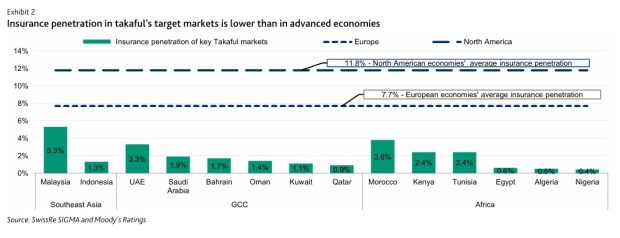
The industry report, titled ‘Global Takaful Sector Resilient Despite Geopolitical Risk, Consolidation to Continue’, highlights that insurance penetration in the kingdom currently stands at 1.7 per cent of gross domestic product (GDP). While this sits above regional peers like Oman at 1.4pc, Kuwait at 1.1pc, and Qatar at 0.9pc, it remains well below the GCC leader, the UAE, which recorded 3.3pc, as well as global benchmarks such as Europe’s average of 7.7pc and North America’s 11.8pc. Southeast Asian market leader Malaysia currently leads target Islamic finance markets with a penetration rate of 5.3pc.
Analysts at Moody’s expect global takaful contribution growth to maintain a moderate upward trajectory, driven by economic expansion and the ongoing rollout of mandatory coverage schemes across the region. In Bahrain and the wider GCC, the expansion of compulsory health insurance mandates and official efforts encouraging consumers to build long-term savings are set to underpin performance, particularly in family takaful, which serves as the Islamic equivalent to traditional life and savings insurance. Uptake of family takaful products is strong in Southeast Asia, and will increase more gradually in Africa and the GCC region.
“Strong economic activity, population growth, and the expansion of compulsory insurance continue to support takaful growth across the GCC. Saudi Arabia remains the world’s largest takaful market, although profitability remains uneven among smaller operators,” said Moody’s Ratings vice-president and senior analyst Mohammed Ali Londe.
Despite favourable growth fundamentals, cost pressures and evolving regulatory landscapes are set to accelerate merger and acquisition (M&A) activity among operators. Financial market supervisors across core takaful jurisdictions are raising minimum requirements for governance, risk management, and risk-based capital. While these regulatory updates support long-term credit quality, they place considerable financial pressure on smaller firms.
Concurrently, heavy capital investments required for digital transformation, including artificial intelligence for underwriting support, fraud detection, and automated claims handling, are reinforcing the competitive scale advantages held by larger institutions.
As a result, industry consolidation is expected to continue across Bahrain and neighbouring GCC countries, ultimately improving pricing discipline, capitalisation levels, and overall governance.
Addressing potential headwinds, Moody’s noted that standard takaful policies generally exclude direct war-related losses, thereby limiting direct underwriting claims exposure from ongoing Middle East regional conflicts.
However, secondary channels present risks. Prolonged regional tensions could create investment market volatility and reduce asset values, challenging earnings for operators who have increasingly relied on investment income to boost profitability. Other operational risks cited include general claims inflation, rising healthcare costs, and climate-related exposure.
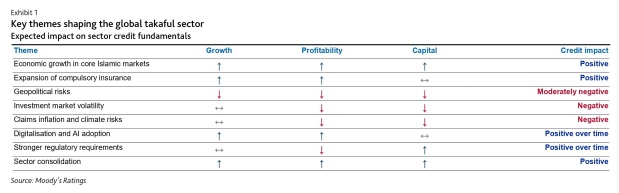
In credit fundamental terms, economic growth, compulsory coverage expansions, digital adoption, and sector consolidation are expected to have a positive impact on the industry’s growth and capital strength over time. Conversely, geopolitical uncertainty, volatile investment markets, and rising claims inflation continue to pose moderate downward risks to sector profitability and capital buffers.
Moody’s Ratings expects moderate growth in global takaful premiums over the next two to three years. The GCC remains a key growth market, with Saudi Arabia continuing to benefit from economic diversification and expanding compulsory insurance requirements under Vision 2030.
avinash@gdnmedia.bh
&uuid=(email))