

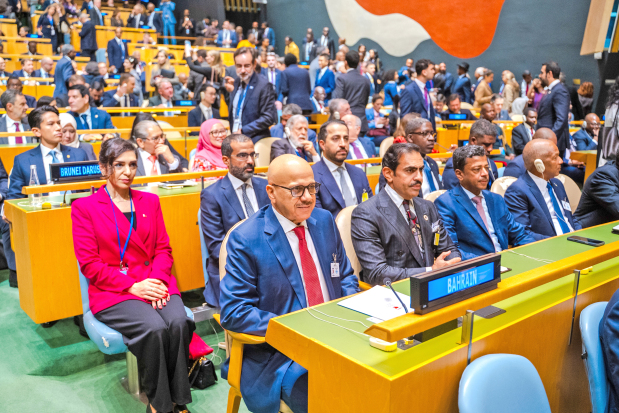
Foreign Minister Dr Abdullatif Al Zayani headed Bahrain’s delegation in the opening session of the general debate of the 81st session of the United Nations General Assembly, which began yesterday at the UN headquarters in New York under the theme ‘Restoring Trust, Managing Transformation: A United Nations that Delivers for All’.
It was chaired by president of the current session of the UN General Assembly Dr Khalil Al Rahman and attended by the UN Secretary General António Guterres.
Bahrain is participating in the session as a non-permanent member of the United Nations Security Council for the 2026-2027 term, reaffirming its firm commitment to the principles and purposes of the UN Charter, its keenness to strengthen multilateral international action, consolidate international peace and security, and contribute to addressing common global challenges.
The kingdom’s delegation included Bahrain’s Ambassador to the US Shaikh Abdulla bin Rashid Al Khalifa, Permanent Representative to the United Nations in New York Jamal Fares Al Rowaiei, Assistant Under-Secretary for Sustainable Development at the Sustainable Development Ministry Dana Imed Hamza, Bilateral Relations director general at the Foreign Ministry Shaikh Abdulla bin Ali Al Khalifa, and ministry’s Co-ordination and Follow-up Sector head Saeed Abdulkhaliq Saeed.
In his opening speech, the UN Secretary General António Guterres called for de-escalation in the Middle East and giving priority to dialogue. He stressed the need to end the fighting, ensure the flow of humanitarian aid, and fully restore the rights and freedom of navigation in accordance with international law.
The Secretary General warned of widening geopolitical divisions and continuing conflicts, noting that the transition towards a multipolar world has become an irreversible process. This, he said, requires a more representative and effective multilateral system grounded in the UN Charter and international law.
He addressed developments concerning the Palestinian issue, highlighting the humanitarian situation in the Gaza Strip and calling for compliance with the international law. He warned that the continuation of violence, displacement and settlement expansion would undermine prospects for achieving a two-state solution.
On reforming the international system, Guterres renewed his call for reforming the Security Council to reflect current international realities, alongside reforming the international financial system and providing stronger support for countries facing debt burdens and development challenges.
Dr Al Rahman said in his address that the UN has continued to serve as an indispensable institution, and that preventing the outbreak of a third world war is among its major achievements. He stressed, however, that its continued existence alone is not a sufficient measure of success, and that its performance must instead be assessed by its ability to deliver tangible results.
He referred to the unresolved Palestinian issue, as well as the wars and conflicts and their repercussions in Sudan, Gaza, Ukraine, Myanmar and the Middle East, while noting the United Nations’ continued provision of humanitarian and development assistance.
He also stressed that international law and international humanitarian law must not be applied selectively, calling for the protection of civilians and ensuring access to humanitarian aid. He emphasised the need to address shortcomings with honesty and realism and through practical action to restore confidence in the organisation.
&uuid=(email))