

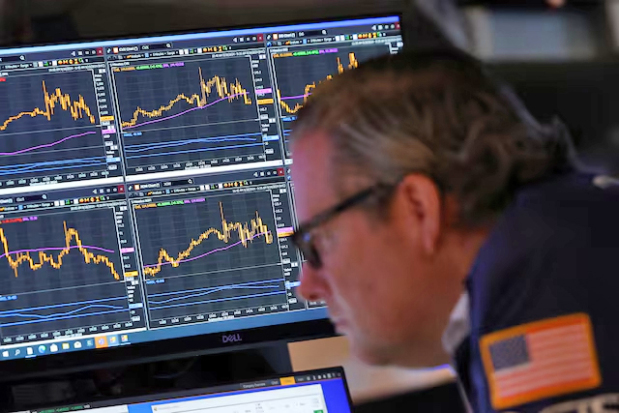
Longer-dated US Treasury yields retreated from earlier highs after 30-year yields touched a more-than-20-year peak, though they stayed elevated as nerves over renewed inflation and further central bank rate hikes kept investors on edge.
Oil prices rose about 2 per cent yesterday as US-Iran diplomatic talks showed little sign of progress, while investors also weighed uncertainty over a potential US ban on diesel exports.
A sharp selloff on Wednesday left global bond investors wary, pushing benchmark 10-year yields to their largest daily increase since the April 2025 tariff turmoil. The move was driven in part by stronger-than-expected US business activity data, which showed prices paid surged to a nearly four-year high this month.
Traders are worried that higher bond yields could derail the equity rally by making borrowing more expensive and drawing investors out of stocks and into bonds. So far, though, financial conditions still appear supportive of a resilient economy and stock market.
“Nothing in the data suggests policy is currently restrictive,” said Antonio Del Favero, head of US rates strategy at Macro Hive. He added that absent a drop of 20pc or more in the S&P 500, and an even steeper decline in the Nasdaq Composite, sustained over an extended period, financial conditions are likely to remain loose.
The MSCI World Index halved in value the last time the 10-year Treasury yield broke above 5pc, shortly before the global financial crisis.
A similar slump occurred less than a decade earlier, when a spike to nearly 6.8pc helped burst the dotcom bubble.
The Dow Jones Industrial Average fell 0.37pc and the S&P 500 dropped 0.23pc. The Nasdaq Composite was down 0.51pc, after reaching a record high on Tuesday.
MSCI’s World Index fell 0.37pc and the pan-European STOXX 600 index dipped 0.16pc.
The interest-rate sensitive US 2-year note yield fell 3.31 basis points to 4.862pc.
The yield on benchmark US 10-year notes fell 0.18 basis points to 5.112pc after earlier reaching 5.1497pc, the highest since 2007.
The 30-year bond yield rose 0.89 basis points to 5.4109pc and earlier peaked at 5.4461pc, the highest since 2004.
Fed funds futures traders are now pricing in 66pc odds of a Fed hike next month, up from around 53pc before the S&P data was released on Wednesday.
“Inflation is high, central bankers are giving hawkish messages, there’s competition from the funding needs of the tech sector and there are no reassuring signs on the US debt trajectory,” said AXA’s Chief Economist Gilles Moec.
Attention now turns to investor demand at yesterday’s $44bn auction of 7-year Treasury notes, following weak interest at Wednesday’s $70bn sale of 5-year debt.
Separately, the Treasury Department said it will buy back up to $6bn in 20- to 30-year Treasuries yesterday, part of a program designed to support market liquidity.
Elsewhere, the yield gap between French and German 10-year debt widened to its broadest level since Mario Draghi’s 2012 “Whatever it Takes” speech.
&uuid=(email))