

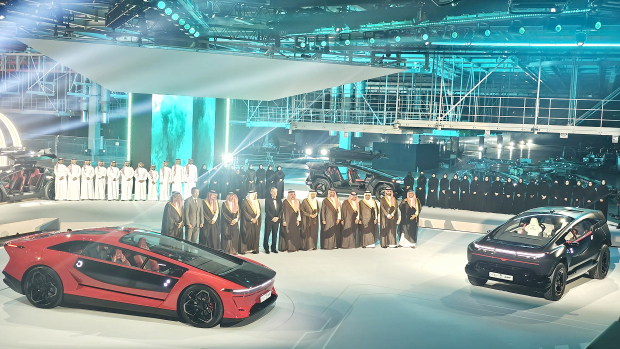
Saudi Arabia’s electric vehicle market has entered a new phase after homegrown carmaker Ceer unveiled its first models, yet analysts say turning consumer curiosity into sales will depend on charging, price and trust.
Crown Prince Mohammed bin Salman, chairman of the Public Investment Fund, launched the Exobot sedan and SUV on September 21, the first vehicles from the Kingdom’s first domestic car brand.
Speaking at the unveiling, Ceer CEO James DeLuca revealed the Crown Prince pushed his team during the design process to ensure the vehicles are set apart from products currently available in global markets
Vivek Sharma, automotive research practice lead for the APP region at market research firm NielsenIQ, told Arab News that a homegrown brand could help change the current consumer behaviour in Saudi Arabia which is ‘high in curiosity and consideration,’ but still at an early stage in actual adoption.
“A homegrown brand such as Ceer could make electric mobility feel more relevant and credible by developing vehicles and services around Saudi conditions and consumer needs,” he said. “It can also connect EV adoption with national innovation, pride and industrial development.”
But local identity alone will not guarantee adoption, he said, with trust dependent on quality, warranties, charging access and after-sales service.
That point was emphasised by Abdulrahman Al-Khaldi, owner of the Emmad Al Deen car dealership in Riyadh and an automotive content creator.
“The issue is that if I drive to Makkah, for example, I would have to stop halfway and spend 30 minutes charging the car. That makes the journey tiring for me,” Al-Khaldi said.
“If charging stations are not widely available, there will not be significant demand for Ceer or electric vehicles in general,” he added.
Charging is also flagged in a new report from management consultancy Arthur D Little.
Its 2026 Global Electric Mobility Readiness Index ranks Saudi Arabia 30th of 31 markets, describing its EV sector as nascent but strategically positioned for growth.
EVs made up less than 2 percent of the kingdom’s roughly 857,000 new vehicle registrations in 2025, the highest total in a decade, according to the report.
The country had about 1,200 charging points at the end of 2025, around 80pc of them AC chargers. High-power charging remains limited, with only a small number of installations along highways and through Tesla’s network, the report said.
Under the Saudi Green Initiative, the kingdom targets 30pc EV penetration in Riyadh by 2030 and plans to expand public charging to several thousand units, Little noted.
PIF launched Ceer in 2022 in partnership with Taiwanese electronics maker Foxconn. The company has said the Exobot models are the first of seven vehicles to be rolled out over the next five years.
All will be built at Ceer’s complex in the King Salman Automotive Cluster in King Abdullah Economic City, which is being developed to produce up to 170,000 vehicles a year, according to the company.
&uuid=(email))