

Bahrain has secured third place regionally in the newly-released Arab Digital Economy Index 2026, solidifying its standing among the elite tier of ‘Technological Sovereignty Leaders’ in the Arab world.
Officially launched during the Seamless Middle East 2026 conference in Dubai, the fifth edition of the landmark report is published biennially by the Arab Federation for Digital Economy under the auspices of the Arab League.
The 2026 index evaluates 22 Arab economies across nine primary pillars – including digital infrastructure, institutional governance, human capital readiness, e-government, and cybersecurity resilience – with a specialised focus on data sovereignty.
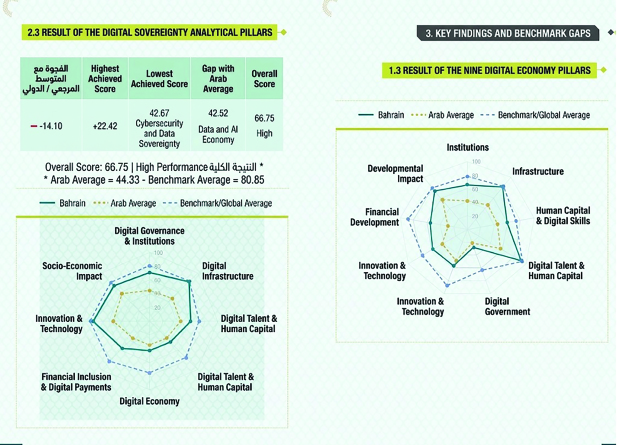
Achieving an overall digital sovereignty score of 66.75 points – well above the Arab regional average of 44.33 – Bahrain placed third overall, closely following the United Arab Emirates (76.66) and Saudi Arabia (73.64), while edging out GCC peers Qatar (66.66) and Oman (65.98).
This top-three positioning reflects the kingdom’s robust digital infrastructure, early adoption of nationwide 5G networks, cloud-first government policies, and progressive fintech regulatory frameworks.
The report highlights Bahrain’s exceptional performance across several key dimensions, anchored by perfect benchmark scores of 100 in Spread and Use of ICT (+29.43 over the regional average), E-Commerce Legislation (+32.84 over the regional average; +12.50 over the international benchmark), and Artificial Intelligence Strategy (+24.55 over the regional average).
In digital infrastructure, the kingdom registered near-perfect results, led by Government Telecom Infrastructure at 98.77 (+31.16 over the Arab average; +6.39 over the international benchmark), Intensity of Digital Services Use at 93.60 (+22.67 regional margin), and Integrated E-Government Services at 90.31 (+44.94 regional margin).
Bahrain also demonstrated robust cybersecurity and governance leadership, recording a Cybersecurity Level score of 97.52 – beating the regional average by +39.85 and standing within 1.68 points of the international benchmark (99.20) – while Emerging Tech Regulation reached 76.30 (+50.68 over the regional baseline).
Strong civic and social engagement further bolstered its standing, with E-Participation reaching 89.85 (+53.22 over the regional average) and top developmental metrics showing significant gains in SDG 3: Good Health and Well-being at 87.20 (+20.98 regional margin) and SDG 4: Quality Education at 85.12 (+26.19 regional margin).
Furthermore, the kingdom showcased advanced ecosystem maturity in financial inclusion, with Bank Account Ownership (percentage of people older than 15) reaching 82 (+40.99 over the Arab average) and Debit/Credit Card Ownership scoring 80 (+48.63 over the Arab average).
Overall, Bahrain’s strongest domain was Cybersecurity and Data Sovereignty (Axis Average: 82.52 vs. Arab Average: 53.19), supported by strong showings in Digital Infrastructure (81.42 vs. 46.91) and Developmental Impact (73.37 vs. 57.40).
Commenting on broader global trends, Arab Federation for Digital Economy chairman Dr Ali Al Khouri noted in the report that digital value creation is rapidly shifting toward artificial intelligence, advanced data analytics, and edge computing.
“Importing turnkey technology alone no longer guarantees strategic digital safety,” Dr Al Khouri added. “True national decision-making independence depends on localising technology, building national data infrastructure, and developing qualified local talent capable of operating these complex systems independently.”
To sustain this competitive momentum through 2030, the report recommends that high-performing tier nations like Bahrain continue capital investment in domestic R&D, expand artificial intelligence ecosystems, and accelerate regional digital market integration.
avinash@gdnmedia.bh
&uuid=(email))