

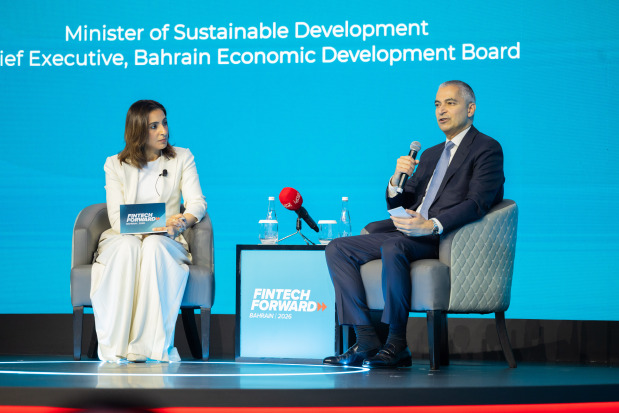
The Central Bank of Bahrain (CBB) is set to increase its investment in financial technology threefold over the next three years, as part of a comprehensive strategy to enhance market security, streamline regulatory oversight, and cement the kingdom’s position as a regional financial hub.
This was revealed by CBB Governor Khalid Humaidan during a high-level fireside chat with Sustainable Development Minister and Bahrain Economic Development Board (EDB) Chief Executive Noor Al Khulaif at the fourth edition of FinTech Forward 2026.
The event, held in at Exhibition World Bahrain, brought together global tech giants, banking institutions, and international delegations from the UK, Switzerland, and across the GCC.
Addressing delegates during the session themed ‘The Bahrain Advantage: Aligning Regulation, Investment and Growth,’ Mr Humaidan emphasised that digital transformation in financial services enhances both market growth and systemic stability.
“Traditionally, central bankers viewed growth and stability as a trade-off,” Mr Humaidan said. “With the adoption of digitalisation in financial services, that equation changes completely – higher growth and greater stability can co-exist.
“Highlighting the pivotal role of Supervisory Technology (SupTech) and Artificial Intelligence (AI), the CBB governor noted that real-time visibility across banking, insurance, and capital markets allows regulators to track transaction flows seamlessly and detect sophisticated financial fraud early.
“When regulatory oversight is tech-enabled, being licensed by the Central Bank becomes a recognised brand seal,” Mr Humaidan explained, adding that continuous regulatory modernisation enhances Bahrain’s overall jurisdiction attractiveness to global investors.
He stressed that trust remains the bedrock of the financial system, noting: “Our primary job as a regulator is to protect user privacy, secure assets, and ensure a level playing field so the public can decide which technologies work best.
“Outlining the sector’s long-term horizon toward 2036, Mr Humaidan pointed out that financial services currently account for roughly 20 per cent of Bahrain’s gross domestic product (GDP). While this market share is expected to remain consistent over the next decade, it will represent a significantly larger and more diversified national economy.
He added that foreign direct investment (FDI) into financial services will continue to expand, with an increased focus on attracting international institutional capital alongside strong regional investments.
Currently, around 1 per cent of Bahrain’s total population works directly in the financial services sector - a metric expected to trend upwards as direct and indirect financial technology roles multiply.
Ms Al Khulaif highlighted Bahrain’s organic success in nurturing local expertise, pointing out that Bahraini nationals currently comprise approximately 70pc of the total financial sector workforce.
She highlighted that global financial leaders such as Citi and JP Morgan continue to establish regional technology centres of excellence and tech hubs in the kingdom, driven by the strength of the local talent pool.
Ms Al Khulaif noted that this year’s Fintech Forward is the largest to date, featuring a newly launched ‘Tech Hub’ supported by Tamkeen aimed at showcasing emerging capabilities and upskilling the next generation of Bahraini talent.
Regarding cross-border co-operation, Mr Humaidan noted that in an increasingly interconnected digital ecosystem, financial regulators must collaborate closely across global jurisdictions.
“None of us can afford to learn solely from our own mistakes - we must learn from international best practices,” Mr Humaidan said, emphasising that standardised regulations enable high-performing companies to scale efficiently across international borders.
avinash@gdnmedia.bh
&uuid=(email))