

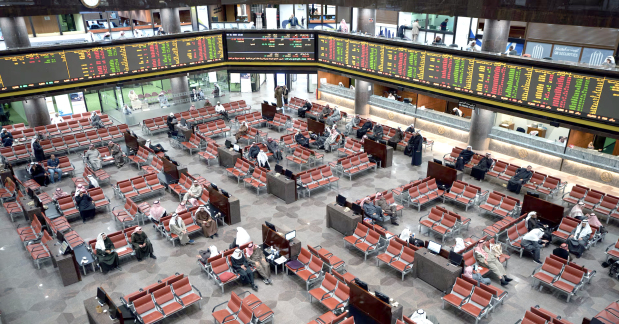
The Bahrain All Share Index closed yesterday at 1,946.67, an increase of 8.94 points from its close on Monday.
The Bahrain Islamic Index closed at 907.67, up 15.33 points from its previous close.
Investors traded 2.90 million shares on the Bahrain Bourse, with a total value of BD720,430, executed through 78 transactions. Investor focus was on the financial sector, which accounted for BD516,750, or 71.73pc of the total trading value, with 2.53m shares traded across 44 transactions.
GFH Financial Group ranked first in trading value, with its shares amounting to BD313,560, which represents 43.52pc of the total traded value.
A total of 1.95m shares were traded through 20 transactions.
Beyon came in second with a value of BD120,666, or 16.75pc of the total value, with 246,940 shares traded through 12 transactions.
Bank of Bahrain and Kuwait was third, with a value of BD72,078, representing 10pc of the total value. This was from trading 141,300 shares in six transactions.
Yesterday, shares of 15 companies were traded. The stock prices of five companies increased, while those of four companies decreased. The remaining companies maintained their previous closing prices.
Most major stock markets in the Middle East fell on Tuesday, with Saudi Arabia’s main index declining for a third consecutive session and nearing levels not seen in two years, according to XTB Mena market analyst Milad Azar.
“The Saudi stock market was on a decline today, marking its third consecutive losing session this week,” Mr Azar said. “The market is trending towards levels last seen two years ago.”
Performance was negative across most sectors, with banking and energy stocks, led by oil giant Aramco, weighing on the market. Aramco’s shares reportedly hit a five-year low.
Markets in the UAE were also subdued. The Dubai stock market closed nearly flat and remains in a “corrective phase” that will require significant positive news to support a potential rebound.
The Abu Dhabi stock market also saw minimal movement, with Mr Azar noting that Monday’s decline could open the door for further losses, while the uncertain outlook for oil prices poses a continued risk.
In Qatar, the stock market was flat amid limited trading as it attempts to stabilise after a three-week correction. The risk of further decline remains, however, due to the absence of any positive catalysts.
Kuwait Bourse closed trading yesterday as the All Share Index gained 72.42 points to reach 8,712.18 points, an increase of 0.84pc.
As many as 455m shares valued at 116.9m dinars ($356.5m) were traded via 27,306 transactions.
The Main Market Index went up by 40.42 points to reach 7,881.67 points, up by 0.52pc, through 223.18m shares done via 14,110 transactions valued at 39.9m dinars ($121.6m).
The Premier Market Index gained 83.99 points to reach 9,349.85 points, up by 0.91pc, through 231.9m shares done via 13,196 transactions valued at 77m dinars ($234.8m).
Meanwhile, the bourse Main 50 Index went up by 71.06 points to reach 8,076.77 points, up by 0.89pc, through stock volume of 177m shares done in 8,905 deals at a value of 31.9m dinars ($97.2m).
Egypt’s stock market trended lower, continuing its correction in line with the broader regional downturn.
Oil prices extended their gains yesterday, supported by a conservative production increase from Opec+ and growing concerns over potential new sanctions on Russian oil, according to Naga market analyst Frank Walbaum.
The Organisation of the Petroleum Exporting Countries and its allies (Opec+) agreed to a modest production hike of 137,000 barrels per day (bpd) starting in October. This cautious approach signalled the group’s intent to keep the market balanced and provided a floor for prices.
Adding to the upward pressure, traders are increasingly concerned about the possibility of tougher sanctions on Russia due to escalations in the war with Ukraine. The US administration has hinted at additional restrictions, which could disrupt global crude oil flows.
On the demand side, robust data from China supported market sentiment. The country’s crude oil imports rose by 4.8pc in August to approximately 49.5m tonnes, with consistent demand and strategic stockpiling helping to absorb global production.
Bitcoin advanced further yesterday, fuelled by renewed institutional interest and positive developments in US cryptocurrency policy, according to Tickmill Managing Principal Joseph Dahrieh.
US spot Bitcoin exchange-traded funds (ETFs) saw $364m in inflows on Monday, signalling a revival in investor appetite.
Corporate activity also provided a boost, with Strategy adding 1,955 BTC valued at $217m to its holdings. This move “reinforce[s] the company’s long-term treasury strategy,” Mr Dahrieh said, highlighting continued corporate demand for the cryptocurrency.
On the regulatory front, momentum is building in Washington. The House Financial Services Committee urged the Senate to approve the Digital Asset Market Structure Clarity Act, which aims to create a federal framework for digital assets. Mr Dahrieh noted that positive regulatory developments could boost investor sentiment and drive further buying pressure.
Additionally, legislation was advanced in the House directing the US Treasury to study the feasibility of a Strategic Bitcoin Reserve and a digital asset stockpile. This follows an order from President Trump earlier this year and reflects a growing international trend, with Kazakhstan and the Philippines also exploring national crypto reserves.
&uuid=(email))