

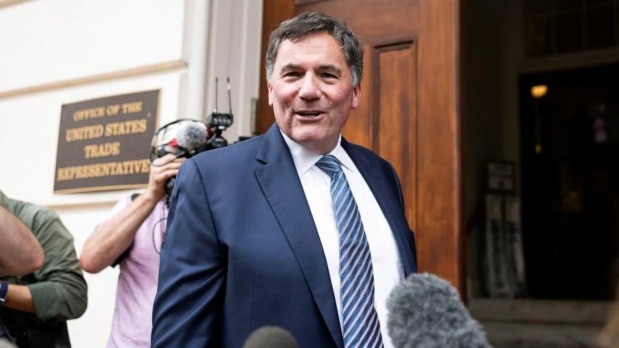
Canada’s minister responsible for US trade Dominic LeBlanc said yesterday that he thought his government could announce retaliatory tariffs on the United States, a day after President Donald Trump threatened to raise US tariffs on all cars and trucks from Canada to 50 per cent.
“I think that’s the government intention,” LeBlanc said when asked on CNBC when the tariffs on goods imported from the US might be announced.
“It shouldn’t surprise anybody. Our friends and the American administration, we said that if we didn’t get to a deal, we would have to take the steps that any responsible government would take to protect those sectors of the economy. Our preference was not to do that,” he said.
Trump on Monday threatened to raise US tariffs on all cars, trucks and automotive parts from Canada to 50 per cent starting January 1, 2027, escalating a trade fight after negotiations collapsed last week.
LeBlanc had spent some eight hours in meetings with US trade representative Jamieson Greer and other negotiators - one of the longest sessions so far as talks go down to the wire.
The trade deal on the table would have cut the top-line tariff rate on Canadian cars and light-duty trucks from 25pc to 15pc and the tariffs on aluminum and steel from 50pc to 25pc, but the deal fell apart on Friday over a number of points of contention, including whether the US tariff relief would have applied to medium- or heavy-duty trucks.
The escalation threatens to disrupt one of the world’s most integrated auto supply chains. US auto production is heavily reliant on Canadian-made parts and vehicles, and higher tariffs could raise costs for American automakers and consumers while deepening a trade standoff that has already weighed on auto stocks.
One of the bigger risks for the world economy is the possible regional impact.
Trump’s fight with Canada could signal the demise of America’s biggest trade agreement: the US-Mexico-Canada Agreement (USMCA). As a reminder, Mexico is America’s largest trading partner, with total goods trade between the two reaching $872bn last year.
USMCA, the revised version of 1994’s North American Free Trade Agreement (Nafta) has been in place for six years but is under serious threat. Trump opted on July 1 not to renew it, subjecting it to annual reviews, although talks are continuing. Unless the three countries agree on fresh revisions, the pact will gradually be wound down and is most likely to be replaced by bilateral agreements, adding yet more uncertainty and complexity to the future of transshipment, investment, and product sourcing in this critical supply chain.
&uuid=(email))