

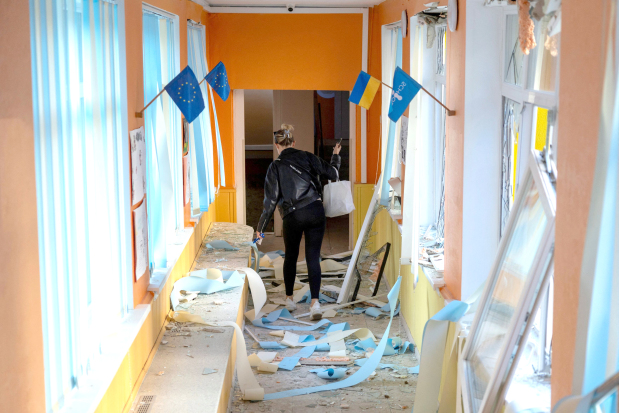
Russia bombarded Kyiv and other cities with missiles and drones overnight, and neighbouring Nato member Poland scrambled jets after a Russian daytime attack in western Ukraine, officials said yesterday.
Over 20 people were injured in the overnight strikes, Ukrainian officials said, following attacks carried out after the US Congress approved a major sanctions bill targeting Moscow.
Sirens sounded yesterday in eastern Poland and two Polish airports temporarily suspended flights after Russia launched its attack in western Ukraine, close to the border with Poland, Polish and Ukrainian authorities said.
“A massive attack on the western part of Ukraine – very close to the Polish border – has just ended,” Prime Minister Donald Tusk said.
The Polish army said no violation of Polish airspace had been registered and that military aircraft had finished their operations.
The airports in Rzeszow and Lublin reopened after their temporary closure.
The US House of Representatives on Wednesday passed sweeping sanctions and tariff legislation championed by late Senator Lindsey Graham that is designed to tighten the economic squeeze on Russia over its 2022 invasion of Ukraine.
The bill has been sent to President Donald Trump to sign into law.
Ukrainian President Volodymyr Zelenskiy called the bill, alongside existing measures, an ‘extremely powerful tool’ that could help force Russia to end its war.
“It is symbolic that the US House of Representatives passed the Lindsey Graham Sanctioning Russia and Iran Act on the night of yet another Russian attack on Ukraine with ballistic and other missiles and drones,” Zelenskiy said.
The Kremlin said yesterday that further US sanctions against Russia would make it harder to reach a peace deal.
The overnight Russian barrage on Ukraine included Oniks anti-ship cruise missiles, ballistic missiles, four cruise missiles and nearly 160 drones, Ukraine’s air force said.
It did not specify the number or say whether any of the more deadly ballistic missiles were intercepted.
Zelenskiy said eight Ukrainian regions suffered damage. In Kyiv, the wail of air raid alerts and boom of air defences sounded through the night and explosions were heard yesterday.
Kyiv Mayor Vitali Klitschko said 20 people had been wounded in the capital.
A Russian drone attack on a Tanzania-flagged vessel en route to a Ukrainian port killed the vessel’s captain and injured three crew yesterday, Ukraine’s infrastructure ministry said.
Six people were wounded in the Black Sea port of Odesa and three in Zaporizhzhia in the southeast, where Russia attacked a plant owned by Ukraine’s largest steelmaker Metinvest for the fourth time in a month.
A building housing equipment of Ukraine’s largest mobile operator Kyivstar was damaged in a strike on the Kyiv region.
The company said it continued to provide services and no employees were injured.
Zelenskiy said Russia had also hit energy infrastructure in the Sumy and Odesa regions and that Ukraine had struck a Russian oil refinery in Yaroslavl, northeast of Moscow. The regional governor said the attack caused a fire that was later doused.
The two sides have continued attacks on energy infrastructure despite Trump announcing they had agreed to stop them.
A Ukrainian drone attack damaged an oil refinery in the Russian city of Yaroslavl, causing a fire that was later doused, regional Governor Mikhail Yevrayev said yesterday on the Telegram messaging app.
The rare acknowledgement by Russian authorities of strikes on oil refineries followed Trump’s announcement of an energy truce between Russia and Ukraine on Monday, although neither side has confirmed any such agreement.
On Sunday, Trump also urged Zelenskiy to stop targeting Russian diesel infrastructure, blaming the attacks for a diesel shortage that is ‘hurting the world.’
Authorities in Russia’s southern region of Krasnodar said a fire broke out at an industrial site after drone debris fell on it.
No injuries were reported and the fire was quickly put out.
Russia and Ukraine have exchanged strikes on infrastructure and other economic targets in recent months, seeking to disrupt each other’s war efforts and undermine morale.
&uuid=(email))