

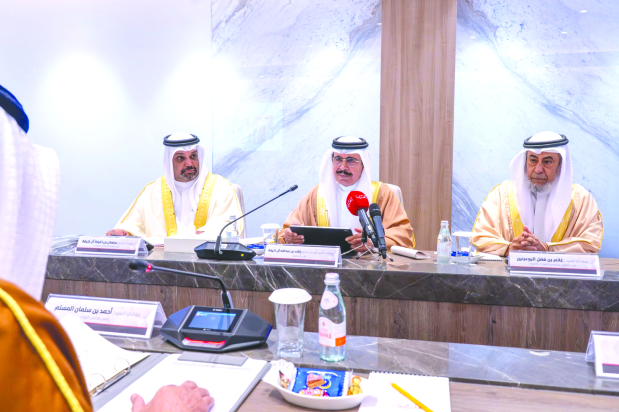
Bahrain’s legislative and executive authorities have held a joint meeting to review the kingdom’s response to the repercussions of the Iranian attacks, with officials stressing the need to maintain national readiness, essential services and close co-ordination as the threat continues.
The meeting brought together senior government officials, MPs and Shura Council members to assess measures taken to protect citizens and residents, maintain supplies and services, respond to emergencies and repair damage caused by the aggression.
The meeting was chaired by National Assembly and Parliament Speaker Ahmed Al Musallam, Shura Council Chairman Ali Saleh Al Saleh, while Interior Minister General Shaikh Rashid bin Abdulla Al Khalifa led the government side.
General Shaikh Rashid said Bahrain’s emergency preparedness was not developed overnight, but was the result of planning and institutional development over the past 25 years.
He said government agencies had worked collectively and proactively, based on continuous monitoring of local and regional developments, to protect citizens and residents and maintain essential services.
Giving details of the national response, General Shaikh Rashid said the Bahrain Defence Force (BDF) had dealt with more than 1,000 Iranian missile and drone attacks.
He said military, security and civilian agencies worked together through established decision-making and emergency mechanisms, including the Supreme Defence Council, Cabinet, Co-ordination Committee, Civil Defence Council and National Civil Emergency Management Committee.
He warned that the continuing conflict meant national preparedness could not be reduced, saying the circumstances required continued co-ordination and additional measures.
Emergency operations rooms and evacuation plans were activated, with 35 shelters prepared across the kingdom to accommodate more than 40,000 people.
Ambulance and medical services were placed on heightened readiness, while authorities also strengthened cyber-response capabilities, monitored supply chains and maintained strategic stocks.
General Shaikh Rashid said electronic warning systems had played an important role in alerting citizens and residents, while security communications, civil defence and emergency medical services were also mobilised.
&uuid=(email))