

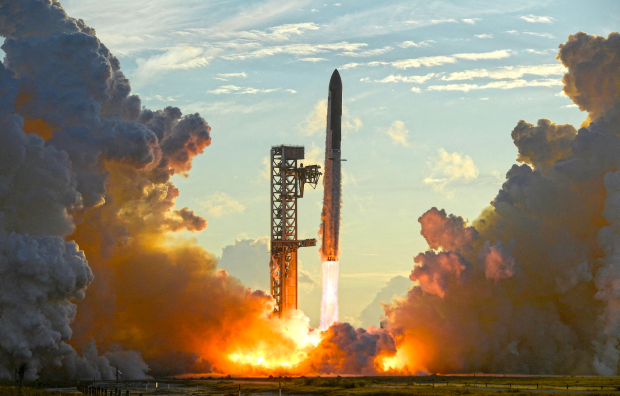
SpaceX’s giant Starship rocket reached orbit for the first time yesterday and deployed new Starlink satellites, achieving key milestones despite an early engine failure and a decision to cut the mission short by seven hours.
The mission was scheduled to last 10 hours, but was reduced to three hours after the engine problem. Launching from Texas, it was the rocket’s 14th flight since 2023, as Elon Musk’s company plans to put the vehicle into routine use starting later this year.
Unlike past Starship flights, yesterday’s mission was both a high-stakes test of the next-generation rocket and an operational endeavour carrying millions of dollars’ worth of Starlink satellites to orbit, representing Starship’s first revenue-generating mission, even though its final design is still under development.
SpaceX shares, which were up nearly 9 per cent from the IPO price, were down about 1pc yesterday. Much of SpaceX’s market worth and continued investor confidence in the company — valued at $2 trillion as of Friday’s close — ride on the success of Starship, which was designed as the world’s first fully reusable spacecraft.
The uncrewed 40-story-tall vehicle, consisting of a Super Heavy booster rocket topped by the main upper-stage Starship vessel, launched from SpaceX’s Starbase complex along the Gulf of Mexico near Brownsville.
The Super Heavy booster lofted the Starship upper stage into space before returning itself to Gulf waters for an engine-controlled splashdown, following hard landings for the booster on two previous missions. Some engines on that booster stopped working during its descent, SpaceX said.
Upon reaching space, one of Starship’s three main engines shut down prematurely, a development that led SpaceX spokesperson Dan Huot to announce on the company’s live stream of the mission that the craft would be unable to reach orbit.
“The team has made the call not to commit to orbit,” Huot said.
But Huot reversed course minutes later after an update from engineers confirmed that the craft could still attempt to fire other onboard engines that would boost it into orbit, which Starship successfully did minutes later.
Once in orbit, Starship deployed 26 next-generation Starlink satellites one by one at an altitude of roughly 269km, marking the ship’s first orbital deployments. “All 26 Starlink V3 operational satellites deployed and operating nominally,” Musk wrote on X.
&uuid=(email))