

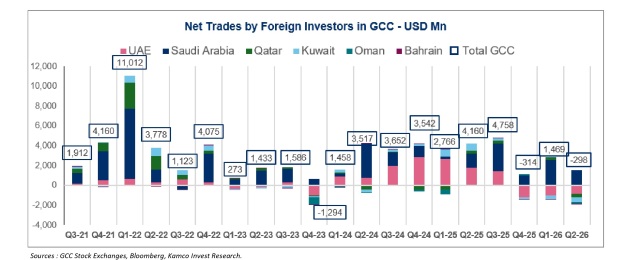
Foreign investors turned net sellers across GCC stock markets in the second quarter of 2026, pulling out a net $298.3 million following strong net purchases of $1.5 billion in Q1, according to recent market data.
Despite the Q2 slowdown, foreign activity for the first half of the year (1H-2026) remained in positive territory with total net buying of $1.2bn. However, this marked an 83.1 per cent year-on-year drop compared to the $6.9bn recorded in 1H-2025.
Regional capital flows were primarily impacted by ongoing geopolitical conflicts, shipping disruptions around the Strait of Hormuz influencing crude prices, global interest rate trends, and lower trading volumes during the Eid holiday season.
Saudi Arabia emerged as the sole bright spot in Q2-2026, attracting $1.6bn in foreign net purchases and partially cushioning the regional outflow.
Foreign investors remained steady buyers in Tadawul across all three months of the quarter, buoyed by the Capital Market Authority’s decision on February 1 to open the market to all foreign investors. For 1H-2026, foreign net buying in Saudi Arabia surged 75.4pc year-on-year to reach $3.38bn.
GCC Trading Activity Quarterly Report - Q2-2026
In contrast, all other GCC exchanges recorded net foreign selling throughout Q2. Dubai led the regional outflows with net sales of $641.5m, followed by Kuwait at $480.3m, Qatar at $375.4m, and Abu Dhabi at $187.3m.
Oman and Bahrain witnessed comparatively lower net selling, amounting to $161.3m and $3.1m, respectively. Meanwhile, GCC regional investors reversed their previous quarter’s stance, shifting to net buyers in Q2 with $62.4m in net purchases compared to net sales of $269m in Q1. Saudi Arabia ($220.7m) and Oman ($127.2m) led regional buy-side interest.
Aggregate GCC trading volume contracted by 21.7pc quarter-on-quarter to 64bn shares. Kuwait was the only market to buck the trend, surging 41.9pc to 17.2bn shares.
Abu Dhabi saw the steepest volume drop at 41.8pc, followed by Oman with a 36.3pc decline and Dubai at 34.9pc.
Despite lower share volumes, total GCC trading value climbed 8.8pc quarter-on-quarter to $157.7bn, driven by higher transaction values in key markets. Traded value in Saudi Arabia rose to $86.4bn from $77.5bn in Q1, while Kuwait jumped to $19.9bn from $12.1bn. Bahrain and Qatar likewise recorded positive quarter-on-quarter growth, with trading values increasing by 15.3pc and 2.5pc, respectively. Overall 1H-2026 trading value stood at $303.6bn, down 4.9pc from $319.3bn in 1H-2025.
Saudi-listed equities continued to dominate regional liquidity, occupying five of the top 10 most traded stocks in the GCC during Q2.
UAE listings claimed four spots, while Kuwait secured one. Together, the top 10 equities accounted for $36.2bn, or 23.1pc of total GCC traded value.
Al Rajhi Bank topped the list of most traded GCC equities in Q2-2026 by generating $6.9bn in trading value, followed closely by Aramco with $6.01bn and Emaar Properties with $5.98bn. Other heavily traded counters during the quarter included Aldar Properties, Saudi National Bank, and ACWA Power.
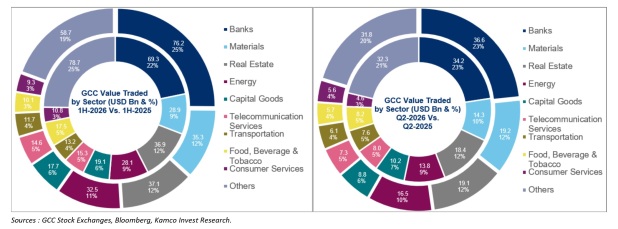
By sector, banking maintained its dominant share, generating $36.6bn in Q2 value up 2.3pc year-on-year led by Al Rajhi Bank, Saudi National Bank with $3bn, and Kuwait Finance House with $2.3bn.
Materials, real estate, and energy also posted value gains, whereas food and beverage suffered a 30.1pc decline and transportation dropped 19pc.
avinash@gdnmedia.bh
&uuid=(email))