

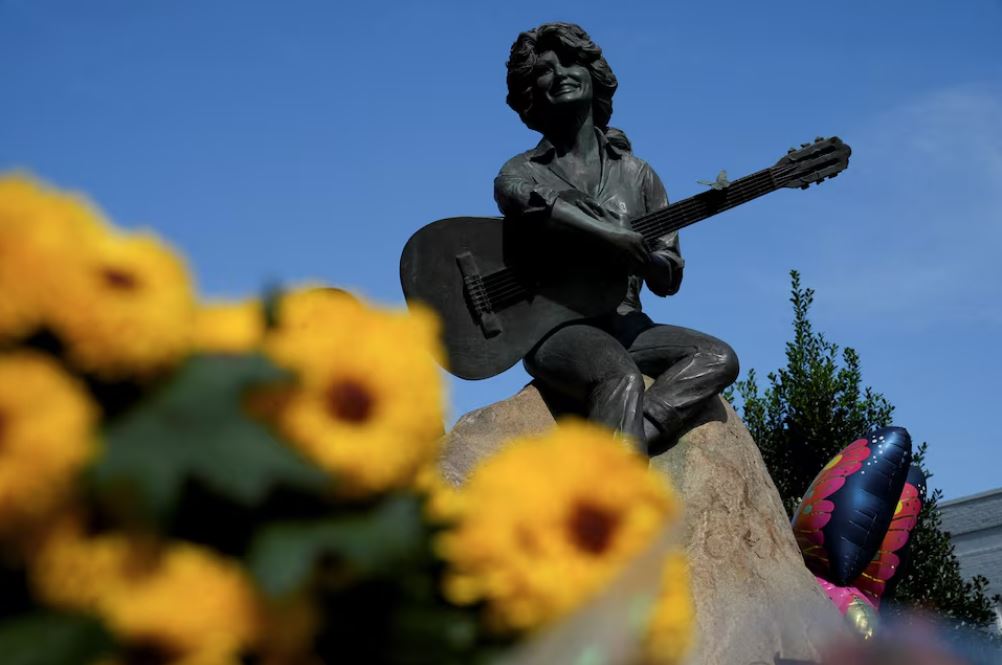
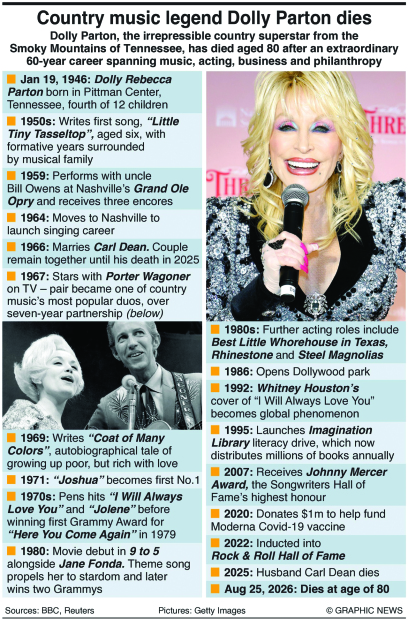
Dolly Parton, the trailblazing country music icon, songwriter and actress who died on Tuesday at age 80, was so much more to millions around the world.
She was a symbol of generosity, whose philanthropic work spanned literacy, disaster relief, medical research and support for marginalised communities and racial justice, transcending the political and cultural divides that reshaped the world around her.
Her charitable efforts were informed by an upbringing in profound poverty in rural Tennessee, which later became as central to her public legacy as the songs that made her famous.
Parton’s philanthropic work included the Dollywood Foundation, established in 1988, to provide scholarships for students in her hometown of Sevierville, Tennessee.
In 1995, she launched Dolly Parton’s Imagination Library, a literacy programme that grew from a local initiative in East Tennessee into an international effort providing free books to children from birth to age five.
“When I was growing up in the hills of East Tennessee, I knew my dreams would come true. I know there are children in your community with their own dreams,” Parton wrote on the programme’s website.
The literacy initiative became one of the most visible expressions of Parton’s charitable legacy.
The programme has gifted more than 304 million books to children in the US, Canada, the UK, Ireland and Australia, according to the programme’s website.
Her philanthropy also included donations to Covid-19 research, the American Red Cross, wildfire and hurricane relief efforts, hospitals and animal welfare causes.
Beyond her music, Parton was a cultural figure embraced by generations of LGBTQ+ fans and communities, earning a reputation for inclusiveness and acceptance. She supported same-sex marriage, criticised restrictions on transgender rights and brought those themes into her work, including the Academy Award-nominated song Travelin’ Thru for the 2005 film Transamerica.
Parton’s warm spirit, deeply resonated with the LGBTQ community, GLAAD President and CEO Sarah Kate Ellis said in a statement.
Throughout her career, Parton rarely waded publicly into politics or social issues.
But in 2018, Parton removed ‘Dixie’ from the name of her Civil War-themed dinner attraction, renaming it Dolly Parton’s Stampede, after receiving criticism for its association with the Confederacy.
“As soon as you realise that something is a problem, you should fix it,” Parton said in 2020.
During the 2020 global protests over the police killings of George Floyd, Breonna Taylor and other Black Americans, Parton notably voiced support for the Black Lives Matter movement , joining the ranks of towering music figures willing to engage publicly on the topic.
“Of course Black lives matter,” she said. “Do we think our little white a#$* are the only ones that matter? No!”
&uuid=(email))