

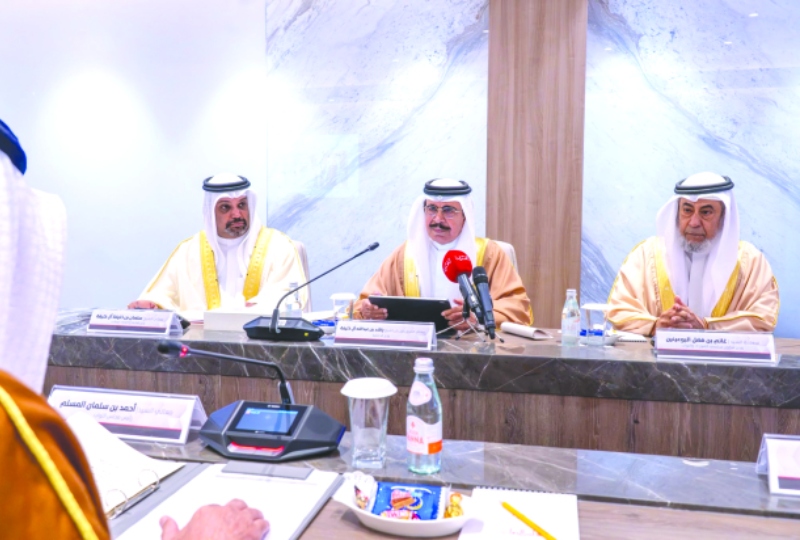
When Interior Minister General Shaikh Rashid bin Abdulla Al Khalifa spoke during the joint meeting with the legislative authority about the national efforts undertaken during the period of the unjustified Iranian aggression, he was not merely reviewing what state agencies and institutions had done during those difficult months. Rather, he was presenting members of the Shura Council and Parliament with a broader picture of the next phase, with all its challenges and changes. He stressed that what happened was no longer a passing exceptional circumstance, but a national experience from which lessons should be drawn as the country enters a new phase of readiness, co-ordination and joint action.
The message comes at a crucial time, with the fifth session of the current legislative term set to begin amid exceptional regional circumstances. Bahrain and other Gulf states have faced significant security challenges, including unjustified Iranian attacks, while wider political, economic and international developments are also expected to influence the course of national work in the coming period.
This underlines the importance of what the Interior Minister presented before the legislative branch when he stressed that national preparedness to deal with crises did not begin with the aggression. Rather, it dates back nearly 25 years to the launch of His Majesty King Hamad’s comprehensive reform project, and the principles it established for co-operation between the legislative and executive branches, the integration of state institutions, the pooling of their efforts while placing citizens at the heart of national action.
This point carries important implications for the legislative role in the coming days. The national preparedness referred to by the Interior Minister is not limited to the military or security dimensions. It encompasses an integrated system covering the state’s ability to protect its citizens, ensure the continuity of services, secure supply chains, guarantee supplies of food, water and medicines, strengthen its capacity to deal with cyber threats, prepare for emergencies and maintain the normal course of daily life under the most difficult circumstances.
The past months have demonstrated that the strength of a state in confronting crises is measured not only by its ability to respond to threats but also by its ability to preserve social cohesion and ensure the continuity of its institutions and services. This makes integration between the legislative and executive branches a national necessity that goes beyond the traditional boundaries of institutional co-operation.
Perhaps the most important message in the Interior Minister ’s remarks was his confirmation that the war and operational circumstances are not yet over, and that the continuation of exceptional conditions requires heightened preparedness, particularly in view of the potential impact of instability on supply lines, the economy and various vital sectors.
It is here that the fifth legislative session assumes importance, coming at a time that requires a new reading of the current reality – not by focusing solely on what has happened but by considering what should come next. The regional and international developments in the past months call for legislation and policies to be developed in line with emerging national security and economic challenges, strengthening the state’s capacity to respond to risks while safeguarding the gains achieved over the years.
This does not mean turning legislative work into an exceptional undertaking. On the contrary, the strength of institutions is demonstrated by their ability to carry out their normal roles efficiently and responsibly under the most difficult circumstances, and to transform the challenges exposed by the crisis into lessons, policies and legislation that strengthen the resilience of the state and society.
Here, the importance of His Majesty’s emphasis becomes clear: preserving national unity, the security and stability of the homeland and its resources remain a fundamental principle to which all sincere national views and proposals must be committed. Their objective is to support social cohesion, sustain the path of development, prosperity and nation-building, and continue achieving further accomplishments for the people of Bahrain and future generations.
This is a highly significant message at a highly sensitive time. Differences of opinion within constitutional institutions are natural and are an integral part of parliamentary work. National unity of purpose does not conflict with diversity of views and perspectives. Diversity in approaches is an essential part of parliamentary work, while the higher national interest and the overarching constitutional framework remain the parameters governing such diversity.
The recent experience has demonstrated the importance of the complementary roles played by the Bahrain Defence Force, the National Guard, the Interior Ministry, and the military, security and civilian agencies, operating as part of a single system that was able to deal with threats, maintain the continuity of services and protect society.
The task today is to ensure that the experience of the past months does not remain merely a record of the challenges that were addressed, but is transformed into a national resource on which legislation, planning and decision-making can be built. This would strengthen national preparedness and enhance institutions’ ability to respond to changing circumstances, while at the same time preserving the principles on which Bahrain’s development process has been built.
The fifth legislative session is not beginning from scratch. It is being launched on the basis of a major national experience that has revealed sources of strength, demonstrated the importance of advance preparedness and confirmed that unity of decision-making, institutional integration and rapid response are indispensable elements in confronting crises.
The message that should remain at the forefront as this session begins is that the coming phase requires a Parliament that is conscious of regional developments, a government that continues to strengthen its response capabilities, institutions that work in a spirit of teamwork, and a society that preserves its cohesion and national unity.
Bahrain is entering this new phase with the experience it has accumulated, the capacity demonstrated by its institutions in dealing with exceptional circumstances, and the leadership’s reaffirmation that the security, stability and national unity of the country remain above all considerations.
Thus, the fifth legislative session becomes more than another constitutional milestone. It is an opportunity to reassess the current phase, draw lessons from its experience and strengthen the state’s ability to confront the changes and transformations that the region may face.
&uuid=(email))