

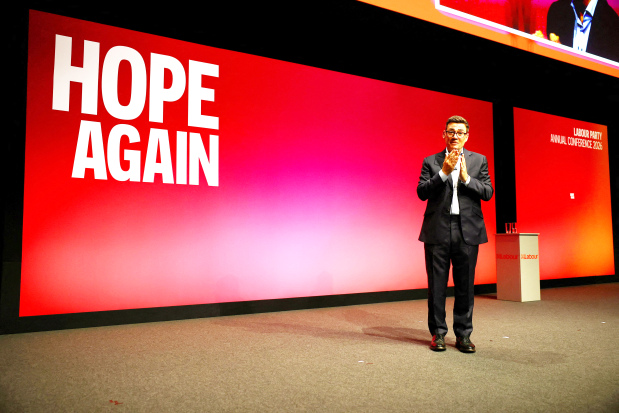
Prime Minister Andy Burnham risked reopening the bitter division over Britain’s departure from the European Union (EU) yesterday by vowing to seek a consensus on closer ties with the bloc.
The promise comes 10 years after Britain voted to leave the EU – a decade marked by political instability, weak economic growth and a divisive debate about how closely the country should tie its fortunes to those of its nearest and largest trading partner.
“Brexit has done more harm than good,” Burnham told the Labour Party conference yesterday, setting out the November summit with the EU as the next step in rebuilding ties. “I will take the opportunity around the summit to lay out to you, to lay out to the country, what I believe the different options are for Britain’s long-term relationship with our European partners,” he said ahead of a planned meeting between the UK and the bloc.
“I will see if we can find consensus around one,” he added.
Polling by YouGov in June showed 55 per cent of voters supported rejoining the European Union and 34pc opposed such a move. When asked separately in the same survey, 59pc supported closer ties with the bloc that did not involve rejoining it in full, its single market, or its customs union.
The EU has welcomed the idea of closer ties with Britain to enhance security and defence, but has not set out detailed aims for the summit.
Burnham’s pursuit of a reformed alliance with the EU is in line with that of his predecessor Keir Starmer, whom he replaced in July, but the desire to find a consensus will test his political skill in a nation still scarred by the tumult of Brexit.
Burnham has barely been prime minister ‘five minutes and he’s already trying to sneak us back into Brussels via the back door,” said Richard Tice, deputy leader of Reform UK — formerly known as the Brexit Party and led by Nigel Farage.
&uuid=(email))