

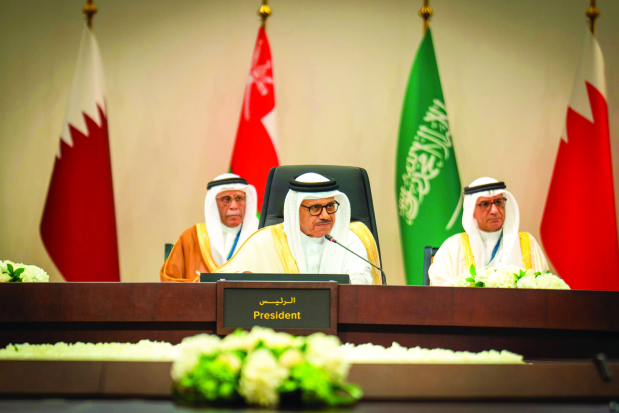
The GCC is stepping up efforts to strengthen global partnerships to safeguard regional security following recent developments, Foreign Minister Dr Abdullatif Al Zayani has said.
He noted that the region has undergone a critical period, with Iranian attacks on Gulf states testing and revealing the strength and resilience of societies, institutions and defence capabilities.
“While physical damage can be repaired, the attacks also disrupted the sense of security and stability long enjoyed by the region’s people,” he said.
However, Dr Al Zayani stressed that these events have strengthened the GCC’s determination to work with international partners to prevent similar incidents and to build a lasting foundation for peace, security, and stability for future generations.
He made the remarks at the Joint Ministerial Meeting between GCC member states and the US, co-chaired by him and US Secretary of State Marco Rubio yesterday.
GCC Secretary General Jasem Mohamed Albudaiwi and ministers from member states attended.
Dr Al Zayani welcomed recent diplomatic efforts that led to a cessation of hostilities through the US–Iran Memorandum of Understanding, supported by mediation efforts by Pakistan and Qatar, as well as the restoration of safe navigation through the Strait of Hormuz. He also welcomed Oman’s announcement of a temporary maritime corridor for vessels transiting the strait.
While describing these developments as encouraging, Dr Al Zayani emphasised the importance of Iran fully honouring all commitments, including those under the memorandum. He added that sustainable regional security requires not only preventing Iran from acquiring nuclear weapons and safeguarding freedom of navigation, but also ending missile and drone attacks, halting support for militias, respecting the sovereignty of neighbouring states, and addressing the consequences of previous attacks in line with UN Security Council Resolution 2817.
He reaffirmed Bahrain’s strong strategic partnership with the US, supported by the Comprehensive Security Integration and Prosperity Agreement (C-SIPA), and expressed the Kingdom’s aspiration to expand co-operation in security, economic development, and technology in support of regional stability and energy security.
Dr Al Zayani also reiterated the GCC’s core principle that the security of its member states is indivisible, noting that any threat to one member constitutes a threat to the Council as a whole, in accordance with the GCC Joint Defence Agreement, which remains the cornerstone of co-operation with partners, foremost among them the US.
Turning to regional priorities, Dr Al Zayani underscored support for the unity, sovereignty and stability of Syria, the preservation of stability in Lebanon, and efforts to advance peace in Gaza through the Board of Peace, aimed at achieving a just and comprehensive settlement.
He expressed hope for ‘a new chapter’ in the region, based on respect for sovereignty, adherence to international law and the protection of international waterways, in partnership with the US.
&uuid=(email))